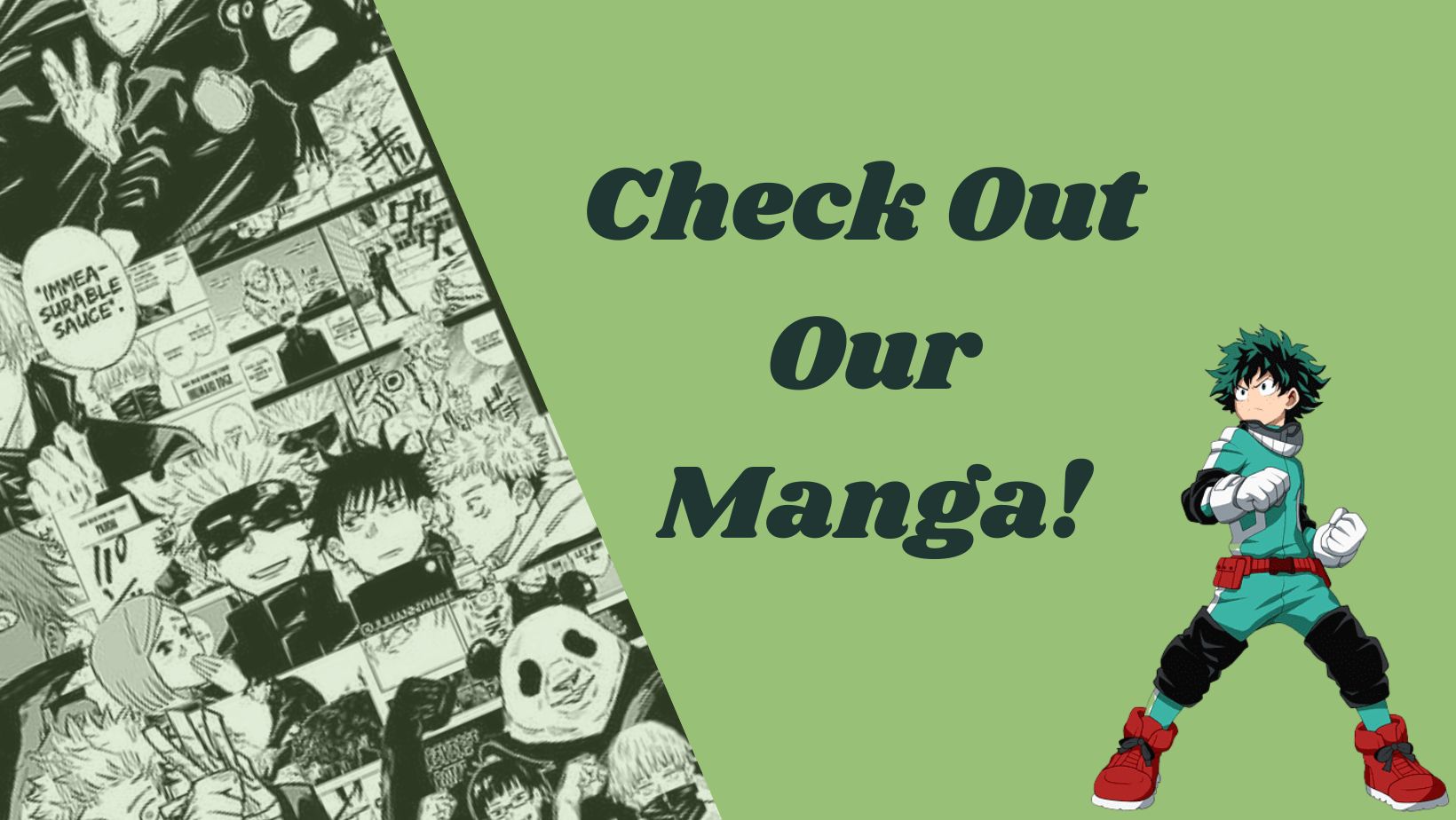
What is Manga?
Manga refers to two Kanji words: “Man” interpreted to mean entertaining or exaggerated; and “ga” which can be interpreted as drawing or image.
Interested to know more about Manga? The History of Manga is located after Series at the Gorham Public Library.
Types of Manga
This section does not mean genres. Most modern Manga are put into different genres there is another way to organize Manga and that is by their target audience. Below is an explanation of the different target audiences.
Komodo Manga: these are written specifically with children in mind. A few examples we have are Pokemon Journeys by Machito Gomi and Splatoon by Sankichi Hinodeya.
Shonen Manga: Written with an adolescent male audience (think teen to young adult) in mind, they usually focus on adventures and friendship. A few examples we have are My Hero Academia by Kohei Horikoshi and
Seinen Manga: Written with a male audience in mind, with more complicated and realistic subjects than shonen.
Shojo Manga: Written with an adolescent female audience (think teen to young adult) in mind, they usually focuse on love and friendship stories of schoolgirls. Nore: the word “Shojo” can also be written as “Shoujo”.
Josei Manga: Written with a female audience in mind, with more complicated and realistic subjects than shoujo.
How to Read Manga
Traditionally, Manga books are read from right to left, the same way as most Japanese writing.
As manga has gained popularity; a new style Manga has started to emerge. This new manga is more of a Western style Manga. These are read left from right.
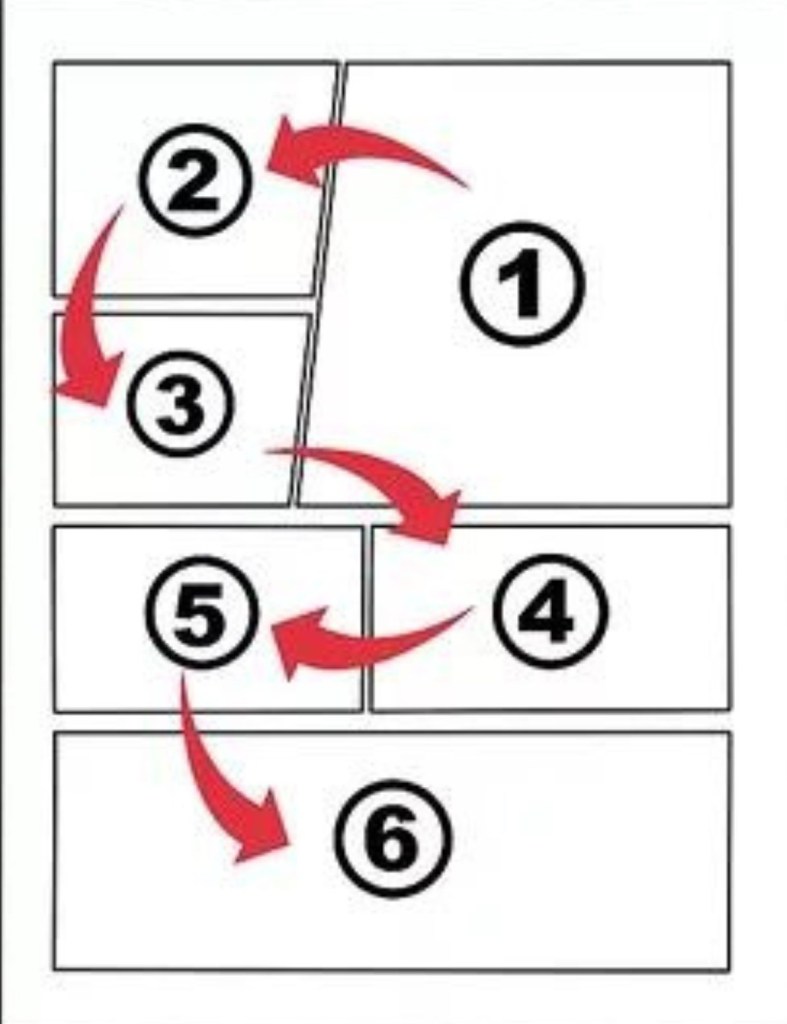

When reading individual panels should be read in a right to left sequence. Start reading each page by beginning with the panel that is in the upper right hand corner of the page. Read right to left and when you reach the edge of the page, go to the panel in the far-right of the following row of panels.
important notes:
- If the panels are all arranged vertically, begin with the topmost panel.
- Panels do not always line up perfectly, when this happens stick to the right left rule. Begin with the highest row or column and make your way -right to left- to the lowest column.
Dialog balloons are from right to left and up to down. Dialog balloons are conversational text between characters, they should also be read in a right to left sequence and follow the same rules that panels do.
Notes:
Black paneled backgrounds (not shown): When a manga panel has a background that is black, it usually means that it is showing a prior event/time then the story. They can also mean the beginning of a flashback.
Fading paneled backgrounds (not shown): black to white indicates the transition from the past to the present. In some manga they use the opposite, white to black, to indicate transitioning to the past.
Series at Gorham Public Library
We have at least one book in these series below. Please check our catalog for which books we have. All series are marked with their targeted audience. We do recommend reading the books before your child and deciding if they are the right fit.
*= is marked as a shonen but we recommend seinen.
- Ascendance of a Bookworm by Miya Kazuki (Shojo)
- Attack on Titan by Hajime Isayama (Seinen*)
- Black Clover by Yuki Tabata (Shonen)
- Boruto by Ukyo Kodachi (Shonen)
- Ceres by Yuu Watase (Shojo)
- Creepy Cat by Cotton Valent (Shojo)
- D-Frag by Tomoya Haruno (Seinen)
- Frankenstein by Mary Shelley
- Fruit Basket by Natsuki Takaya (Shojo)
- Guardian Angel Getten by Minene Sakurano (Shojo)
- Hatsune Mix by K.F.I. (Shonen)
- Jujutsu Kaisen by Gege Akutami (Seinen*)
- Maximum Ride by James Patterson
- Mob Psycho 100 by One (Shonen)
- My Hero Academia by Kohei Horikoshi (Shonen)
- Naruto by Masahi Kishimoto (Shonen)
- One Punch Man by Yusuke Murata (Shonen)
- Parasyte by Hitoshi Iwaaki (Seinen)
- Pokemon Journeys by Machito Gomi (Komodo)
- Remina by Junji Ito (Seinen)
- Remote by Seimaru Amagi (Seinen)
- Skip Beat by Yoshiki Nakamura (Shojo)
- Splatoon by Sankichi Hinodeya (Komodo)
- Witch and Wizard by James Patterson
- Zelda: Ocarina of Time by Akira Himekawa (Shonen)
- Zelda: Twilight Princess by Akira Himekawa (Shonen)
History of Manga:
Mara and Heian Period or Kamakura Period
(12th century or 13th century)
Believed to be the very first manga released. A series of drawing titled Choju-giga (translation: Scrolls of Frolicking Animals) by different artists. Many Manga artists adopted the drawing technique for running characters from this series.
Endo Period
(1603-1868)
Another book of drawings called Toba Ehon (translation: Toba picture book), was released that also had the same concepts as early Manga.
1798
The term Manga is first used to describe the picture book Shiji no Yukikai (translation: Four Seasons) by Santo Kyoden.
1814
The term Manga shows up again in the title of Aikawa Mina’s Manga hyakujo
1814
Hokusai Manga is published, one of the masterpieces by Katsushika Hokusai (1760-1849). It depicting ordinary people s lives, animals, plants, landscapes and human figures, historical and supernatural, even demons and monsters, as if it were a visual encyclopedia, amounting to fifteen volumes.
1862
Charles Wirgman Publishes Japan Punch. A magazine written in English and intended for Westerners. It featured satirical cartoons.
1890
Manga appeared as a translation for the Western concept of caricature.
1900
Monthly Shojo magazines begin to appear.
1902
A man named Imaizumi Ippyo was the first comic artist to label his work as a manga, changing the meaning of manga from caricatures to a broader definition. Manga is more focused to children at this time.
1923
A 4-panel comic introduced; possibly the first of it’s kind, in a Hochi Newspaper. This comic also featured speech bubbles.
1933
Emergence of Akahon (Redbook) Manga. The paper quality used was much cheaper than regular manga. Making this available for children who did not have a lot of money.
1945
Occupation Period during World War II. Between the years 1945 to 1954 the U.S. occupied Japan to do widespread reforms. This led to anti-American sentiment which can be seen throughout manga series years later.
1948
Osamu Tezuka, author of the Manga series Astro Boy, changed the focus of manga from gags to stories with a message.
1954
First anti-Manga campaign called Don’t Buy, Don’t Read, Don’t Look created by the Akasaka Association of Boy’s Mothers. This campaign was to discourage the public from purchasing manga because of the belief Manga was becoming too violent.
1956
Artists like Shirato Sanpei produce more violent and dramatic pieces in contrast to Tezuka, later in 1957 would be called “gekiga.” Genkiga is used to describe any manga with violence or passion or any spectacle.
1959
A new genre called Shonen Manga appears. This Manga moves away from genkiga and focused towards younger males and focuses more on adventures, friendship, and overcoming challenges.
2009
A Manga publishing company called Vertical Inc. decided to flip a Manga called Chi’s Sweet Home. The idea was that the book could be enjoyed by non-Manga fans. This idea paid off during the books release as it became a NY Times bestseller.
Today
Manga is on the rise and becoming more popular as time goes on!